Run Parametric
File › Run Parametric… makes a new drawing from a parametric drawing file (.piq), asking first for the values of its labelled variables: a box style's length, width and depth, its flap, its board, whether it has a lid. The file is then run with those values, so whatever it works out from them (points, lines, loops and choices) follows.
Choosing the drawing
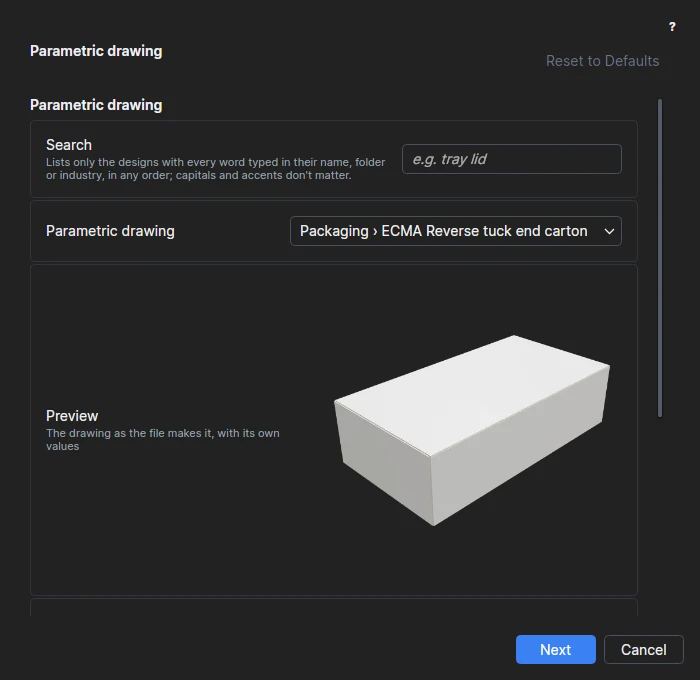
The drawings listed are the .piq files in the Parametric folder of each Extensions folder, and in the folders in it: your own (File › Extensions › Open Extensions Folder, then make a folder called Parametric in it) and the app's. Each is listed by its folder and name (Packaging › Sleeve), so a folder groups a trade's drawings. A file of yours at the same place as one of the app's is listed instead of it. Under the list is a preview of the chosen drawing, run with its own values: for the app's own drawings, a photo-quality picture of what it makes in 3D (its flat drawing, if it makes nothing in 3D or only a thin flat sheet - not put together from parts, its longest size more than 50 times its thickness - as a rug, a pane of glass or a gasket, unless the design asks for 3D); for yours, the drawing it makes, or the same kind of picture once you have made their thumbnails. Then what the file says it is: the comment lines it starts with. Another file… opens any .piq file. Start from a product…, under them, goes to New from Product instead: from what you are packing, it chooses and sizes the fitment and the outer.
The drawing made can be changed in the same way afterwards: tick Run View in the Variables panel.
Recent designs
The designs you have run lately (up to ten, the last first) are offered first: while there are any, Designs chooses between Recent designs, a list of them, and All designs, every drawing in the library and Another file…; the preview and description follow the drawing chosen in the list shown. The list chosen last time is shown again (Recent designs to begin with). A design run from another file is listed by its file name; one that is no longer there is left out.
File › Recent Designs lists the same designs, each with its library picture if it has one: choose one to run it again, its values asked for as usual (without choosing the drawing first). The list is kept in the app's settings on this computer. Clear List, at the bottom of File › Recent Designs, forgets them all at once, without asking (the designs themselves are not touched): until you run another, Designs shows only All designs.
Pictures of your own designs
File › Extensions › Make Thumbnails… pictures your own designs as the app's are pictured: for each .piq file in the
Parametric folder of your Extensions folder, and in the folders in it, a picture of what it makes in 3D (or of its flat
drawing), saved beside it with the same name (Tray.webp beside Tray.piq). It works in the background, showing how
far it has got; Cancel stops it, keeping the pictures already made. When it finishes it says how many it made, how
many were already up to date, and which designs couldn't be pictured, and why.
The preview here and File › Recent Designs then show those pictures. A picture is used only while its design is as
it was when the picture was made (each design's hash, and whether its picture is in 3D or of its flat drawing, are kept
in thumbnails.json in the Parametric folder): once you change a design, its preview is its drawing again until you
make the thumbnails again, which then pictures only the designs added or changed since.
A thin design that looks better made than flat (a coaster set, a sign blank) can ask to be pictured in 3D with a
comment line of its own, // THUMBNAIL=3D; // THUMBNAIL=FLAT asks for its flat drawing. Being a comment, it changes
nothing the design draws or exports.
Searching
Search, above the lists, keeps in them only the designs with every word you type in their name, their folder or
their industry, in any order, as you type: lid box finds the boxes with a lid (Packaging ›
Archive box with lid flap, Laser cutting › Box with sliding lid …), sheet bracket the sheet-metal brackets. Capitals and accents don't matter (climatizacion
finds Climatización), names are matched as the list shows them (your own folders and designs in whatever language
you named them), and the industry by its name in the app's language as well as by its folder (in Spanish, chapa
finds the Sheet metal designs). It searches the list shown, Recent designs or All designs; Another
file… stays in the full list. When the list shown has no design the search finds, the description says so, and
Next opens another file instead.
Packaging styles
In the Packaging folder. The app comes with these, each drawn on its inside length, width and depth (L, W, D), with a choice of
material, T: its thickness is allowed for in the panels, flaps and slots, so the box made holds the size asked for.
Corrugated styles offer E, B and C flute and EB and BC double wall; folding cartons offer boxboard from 0.35 mm to
solid board, and F and E flute. Each prints the size of its blank.
| Drawing | What it is | Its own settings |
|---|---|---|
| FEFCO 0200 Half slotted container | A slotted case with no top flaps | Glue flap, hand holes |
| FEFCO 0201 Regular slotted container | The everyday shipping case (RSC), its outer flaps meeting in the middle | Glue flap, hand holes |
| FEFCO 0202 Overlap slotted container | An RSC whose outer flaps overlap | Glue flap, overlap, hand holes |
| FEFCO 0203 Full overlap slotted container | An RSC whose outer flaps are the full width | Glue flap, hand holes |
| FEFCO 0204 Centre special slotted container | Inner and outer flaps all meeting in the middle | Glue flap, hand holes |
| FEFCO 0427 Mailer | A one-piece postal box: rolled-in front and sides, ears, a hinged lid with a tuck | |
| Telescope base and lid | A base and a lid that slides over it, each a tray with corner flaps | Lid depth, corner flap |
| ECMA Reverse tuck end carton | A folding carton, its tucks on opposite panels | Glue flap, tuck, window |
| ECMA Straight tuck end carton | A folding carton, both tucks on the back panel | Glue flap, tuck, window |
| ECMA Seal end carton | A folding carton closed by glued, overlapping flaps | Glue flap, overlap, window |
| Sleeve | Four panels and a glue flap, open at both ends | Glue flap, window |
| Pillow box | Two panels, the ends curved and pressed in; D sets the curves |
Glue flap |
| Matchbox drawer and sleeve | A tray with corner flaps, and a sleeve it slides into | Corner flap, glue flap, thumb notches |
| Tray | A tray with corner flaps: a sample of every kind of control, to copy (at the top of the list, not in a folder) | Flap, taper, grade, lid, customer |
| Crash-lock bottom box | A corrugated case with an auto bottom (glued diagonal tabs) and slotted top flaps | Glue flap |
| Snap-lock bottom box | A 1-2-3 bottom, the tongue locking into a notch; no tape | Glue flap, tuck lid or slotted top |
| Half slotted box with lid | A half slotted base and a separate telescope lid | Glue flap, lid depth or full-depth lid |
| Wrap-around case | A one-piece case wrapped round the product and glued, with end flaps | Glue flap |
| Five-panel folder | A book wrap: bottom, walls, top flaps, end walls and ears | Top flaps meeting or overlapping |
| Roll-end tuck-front mailer | An e-commerce mailer: rolled walls with lock tabs, dust flaps, tuck lid | Thumb notch |
| Self-locking tray | Ears trapped in double end walls, tabs locking into the bottom; no glue | |
| Tray with glued corners | A four-corner tray, its end-wall flaps glued inside the sides | Corner flap, hand holes |
| Display tray with front window | A shelf-ready tray, its front cut down between corner posts | Front height, hand holes |
| Pizza box | Rolled double walls with lock tabs, a tuck lid, vents | Thumb notch, steam vents |
| Bottle shipper partitions | A slotted divider set: a long and a short strip, sized from the cell; quantities and the case size printed | Partition height, cells each way |
| Bin box with hand hole | An open-top picking bin: low front, sloped sides | Glue flap, front height, hand hole |
| Archive box with lid flap | A storage box with a lid hinged on the back, tuck and dust flaps | Glue flap, tuck, hand holes |
| Insert pad with fold-up edges | A layer pad or shelf divider with fold-up edges | Edge height, two long or all four edges |
| Crash-lock bottom carton | A folding carton with an auto-lock bottom and a tuck top | Glue flap, tuck |
| Snap-lock bottom carton | A folding carton with a 1-2-3 bottom and a tuck top | Glue flap, tuck |
| Carry carton with centre handle | A crash-lock carton whose top halves fold up into a double handle | Glue flap, handle height, hand hole |
| Bakery box with tuck lid | A one-piece tray with glued corners and a lid with dust flaps and tuck | Corner flap, tuck, window |
| Dispenser carton with tear-off front | A reverse tuck carton with a tear-off opening in the front | Glue flap, tuck, opening, thumb notch |
| Cereal carton with tear strip | A seal end carton with a tear strip and pull tab | Glue flap, overlap, plain top or tear strip |
| Retail sleeve with hang tab | An open-ended sleeve with a header and euro hole | Glue flap, tab height, thumb notches |
| Bottle carrier with handle | A 4- or 6-bottle crash-lock carrier with neck holes and a double handle | 4 or 6 bottles, neck hole, handle |
| Wallet folder with tuck flap | A CD or card wallet: low walls, spine, a cover with a tuck | Tuck |
| Gift box with hinged lid | A one-piece box, the lid's skirts outside the walls, its tuck inside the front | Corner flap, skirt, tuck |
| Counter display tray with header | A display tray whose back rises as a header | Front height, header height, corner flap |
| Corner window carton | A reverse tuck carton with a window on the front or round the corner | Glue flap, tuck, window, border |
| Hanging tuck end carton | A tuck carton whose back panel rises as a header with a euro hole | Glue flap, tuck, header height |
| Hexagonal tuck end carton | A six-sided tube with hexagonal tuck lids and dust flaps | Glue flap, tuck |
| Triangular prism carton | A bar-style triangular tube with tucked end triangles | Glue flap, tuck |
| Gable-top carry carton | A crash-lock carton with a sloped gable roof and a double handle | Glue flap, handle height, hand hole |
| Gusset corner tray | A one-piece tray whose web corners fold in against the end walls | Hand holes |
| Pyramid carton | A square-based pyramid with glue flaps | Glue flap |
Cut lines are on layer 0 (Cut), folds on layer 1 (Crease). A crease folds 90° in the 3D view unless it says how far
(RULE FOLD=60, see element settings): the hexagonal, triangular, gable, gusset and
pyramid styles' creases do. The 3D view folds a style up in a natural order (the walls, the flaps on them, then the
panels that close it); where a style needs another, its creases say when they fold (RULE STEP=2), as the full
overlap container's do. To change one, copy it to your own Parametric folder and
edit it there.
Other industries
Parametric drawings from other trades, each in its industry's folder, sized by its material where the material changes the shape: a thickness and K-factor for a bend, a kerf for a laser, a seam allowance for a fabric, a pipe's outside diameter. Bends and folds are on layer 1, cut lines on layer 0; each prints what it makes.
| Drawing | What it is | Material, and its own settings |
|---|---|---|
| Sheet metal › Enclosure tray | A box bent up from one blank, corners relieved | Steel, galvanised, stainless, aluminium or copper (its K-factor) and thickness; bend radius, fixing holes |
| Sheet metal › Angle bracket | A 90° bracket with holes in each leg | As above; holes in each leg, hole size |
| HVAC › Rectangular duct | A duct section wrapped from one sheet, closed with a Pittsburgh lock | Galvanised, aluminium or stainless gauge; lock and end allowances, cross-breaks |
| HVAC › Concentric reducer | A cone frustum developed flat, on the mean diameters | Gauge or plate thickness; seam allowance |
| Pipework › Branch saddle template | A wrap-round template to cut a branch to fit a main at 90° | Each pipe by material and size (steel, stainless, copper, PVC-U) |
| Laser cutting › Finger-jointed box | Five or six panels with finger joints | Plywood, MDF, acrylic or card: thickness and kerf; finger width, lid |
| Gaskets › Flange gasket EN 1092-1 PN16 | A full-face or inside-bolt-circle gasket, DN15 to DN200 | Fibre, rubber, PTFE or graphite (thickness, hole clearance); tab |
| Carpentry › Stair stringer | A cut stringer: equal risers, the throat and pitch worked out | Timber section; going, rise, largest rise, nosing |
| Sewing › Tote bag | Body pieces with boxed corners, and handles | Cotton, canvas, denim, linen or faux leather (seam allowance and hem); handle size |
| Structural steel › Column base plate | A plate with holding-down bolt holes and a grout hole | Bolt (hole and edge distance) and plate grade and thickness; six bolts |
| Sheet metal › U channel | Two bends the same way, holes in the base | As above; holes, pitch |
| Sheet metal › Z bracket | A joggle: two opposite bends, marked up and down | As above; holes in each flange |
| Sheet metal › Hat section rail | A top-hat rail with four bends and staggered fixing holes | As above; holes, pitch |
| Sheet metal › Open box with corner tabs | An open box, the long sides' tabs wrapping the corners | As above; tab width, rivet holes |
| Sheet metal › Shelf bracket with gusset flanges | An L bracket stiffened by tapered side flanges | As above; gusset depth, holes |
| Sheet metal › Electrical junction box | A box with lid flanges, knockouts and fixing holes | As above; flange, knockout size and count |
| Sheet metal › Mounting plate with slotted holes | A plate with corner slots and rounded corners | Thickness; slot size and direction, middle holes, folded edges |
| Sheet metal › Equipment chassis with return flanges | A pan with mitred return flanges all round | As above; cover screw holes, feet holes |
| Sheet metal › Corner gusset | A triangular stiffener with a corner snipe | As above; snipe, lightening hole, bent flange |
| Sheet metal › Hemmed edge panel | A panel with closed or open hems, mitred where they meet | As above; edges hemmed, hem width |
| Sheet metal › Vent panel with slots | A grid of round-ended slots, straight or staggered; open area printed | As above; slot size, border, flange |
| Sheet metal › Cable tray section | A perforated tray: base, sides, lips, coupler holes | As above; slot size and pitch |
| HVAC › Segmented round elbow | End and middle gore patterns from the cylinders' intersection | Material; 3–7 pieces, seam, end collar |
| HVAC › Square to round transition | A one-piece pattern by triangulation, its bend lines marked | Material; offsets, seam allowance |
| HVAC › Rectangular transition | A one-piece rectangle-to-rectangle pattern, concentric or offset | Material; corner seam, end allowances |
| HVAC › Rectangular radius elbow | Cheeks, throat and heel wraps | Material; Pittsburgh pocket, male flange, end allowances |
| HVAC › Rectangular offset | Ogee cheeks and two equal wraps | Material; pocket, male flange, end allowances |
| HVAC › Lateral branch | A branch pattern and the matching hole in the main | Material; angle, seam |
| HVAC › Dovetail spigot collar | A take-off collar with locking tabs, bead and crimp | Material; tab depth and pitch, crimp, lap |
| HVAC › Round end cap | A disc with a turned edge and a band, slip-over or crimped | Material; edge seam, crimp, lap |
| HVAC › Eccentric reducer | A reducer flat on one side, by triangulation | Material; seam allowance |
| HVAC › Rain cap cone | A cone and its support straps | Material; legs, lap, strap width |
| HVAC › Shoe take-off | A 45° shoe: cheeks, heel and a toe with notched flanges | Material; flange, tab, top allowance |
| Pipework › Mitre cut template | A wrap-round template for a mitred bend's cut | Pipe; bend angle, joints |
| Pipework › Lobster-back bend segments | Templates for the segments of a segmented bend | Pipe; angle, segments, bend radius |
| Pipework › Lateral branch template | A branch cut to sit on a main at any angle | Each pipe; angle |
| Pipework › Offset branch template | A branch at 90°, off the main's centre line | Each pipe; offset |
| Pipework › Branch hole template | The hole in the main for a branch, developed flat | Each pipe; angle, offset, set-on or set-in |
| Pipework › Branch on a reducer template | A branch cut to sit square on a concentric reducer | Reducer and branch; position |
| Pipework › Tube to plate at an angle | A tube-end template and its oval on the plate | Tube; angle, mark or cut the oval |
| Pipework › Insulation jacket wrap | A cladding sheet with laps and fixing holes | Pipe, insulation and cladding; laps, holes |
| Structural steel › Splice plate | A flange or web splice with a bolt group each side | Bolt and plate; bolts along and across |
| Structural steel › Fin plate | A shear tab with bolt lines and a corner snipe | Bolt and plate; bolts, lines, snipe |
| Structural steel › Beam end plate | An end plate with its bolt pattern and the beam's outline | Beam, bolt and plate; flush or extended |
| Structural steel › Web stiffener | A stiffener with root-radius snipes, cut as a pair | Beam and plate; fitted or short |
| Structural steel › Bracing gusset plate | A corner gusset with the brace's bolt group at an angle | Brace angle, bolt, plate; bolts, lines |
| Structural steel › Lifting lug | A padeye with a rounded head and pin hole | Shackle pin and plate |
| Structural steel › Angle cleat pair | Two web cleats opened out, both hands | Angle, bolt; bolts per leg |
| Structural steel › Beam cope template | A cope sized from the supporting beam | Both beams; cope the bottom too |
| Gaskets › Flange gasket ASME Class 150 | A full-face or inside-bolt-circle gasket, NPS ½ to 12 | Material (thickness, hole clearance); tab |
| Gaskets › Rectangular flange gasket | A band gasket with evenly spaced holes and rounded corners | Material; band, bolt, pitch, corner radius |
| Gaskets › Manway gasket | An elliptical or obround manway gasket | Material; band width, shape |
| Gaskets › Spiral-wound gasket rings | The centring and inner rings' outlines | Ring material; diameters |
| Gaskets › Blind and spade plate | A Class 150 blind plate, or a spade with a handle | Size, plate |
| Gaskets › Round gasket with bolt holes | A round gasket of any size with evenly spaced holes | Material; holes, full face |
| Gaskets › Pass partition gasket | A heat-exchanger channel ring with a bar or a cross | Material; two or four passes |
| Laser cutting › Involute spur gear | A gear with involute teeth, a bore and keyway | Material and kerf; module, teeth, pressure angle |
| Laser cutting › Living-hinge panel | A panel with a slot lattice that lets it bend | Material and kerf; bend angle, radius |
| Laser cutting › Tab-and-slot bookshelf | Sides, tabbed shelves and a back rail that slot together | Material and kerf; shelves, feet, back rail |
| Laser cutting › Phone stand | Two interlocking parts with a ledge and lip | Material and kerf; phone thickness, lean |
| Laser cutting › Coaster set | Coasters with an engraved border | Material and kerf; shape, how many |
| Laser cutting › Name sign | A rounded-corner sign with holes and an engraved border | Material and kerf; holes, border |
| Laser cutting › Pegboard panel | A peg-hole grid with fixing holes | Material and kerf; pitch |
| Laser cutting › T-slot enclosure | A six-panel box with T-slot screw joints and nut traps | Material and kerf; screw size, lid |
| Laser cutting › Box with sliding lid | A finger-jointed box whose lid slides in grooves | Material and kerf; finger width, finger hole |
| Laser cutting › Cable comb | A strip with cable slots and screw holes | Material and kerf; cables, open or snap-in |
| Laser cutting › Hexagonal planter | A polygon planter or lamp: base, ring and side panels | Material and kerf; sides, windows |
| Laser cutting › Tray with handles | A finger-jointed tray with raised ends and hand holes | Material and kerf; finger width, handles |
| Carpentry › Common rafter | A pattern rafter: ridge cut, birdsmouth, eaves tail | Timber; pitch, overhang, ridge board, tail cut |
| Carpentry › Bookcase | A cutting list: housed sides, top, shelves, plinth, back; housings marked | Board; shelves, back, plinth |
| Carpentry › Cabinet carcass | A base cabinet's parts with housings, rebates and shelf-pin holes | Board; back, toe kick, adjustable shelf |
| Carpentry › Table legs and aprons | Legs with mortises and aprons with tenons | Leg size, apron depth, overhang, taper |
| Carpentry › Mitred picture frame | Four mitred mouldings, the rebate marked | Moulding (slim, standard, wide or box); mount border |
| Carpentry › Shaker door | Stiles, rails and a panel with movement allowance | Stile and rail width; stub tenon or mortise and tenon |
| Carpentry › Workbench | A cutting list: top, housed legs, rails, shelf | Leg and rail timber, top, shelf |
| Carpentry › Arch template | A segmental, semicircular or pointed arch with its brick ring | Shape, ring |
| Carpentry › Dovetail template | The tail board and pin board for through dovetails | Tails, slope, pin width |
| Carpentry › Pergola rafter tail | A shaped rafter end and its beam notch | Timber; tail style, notch |
| Sewing › Drawstring bag | Two pieces with a casing for two cords | Fabric; base depth, casing |
| Sewing › Zip pouch | A lined zip pouch, boxed or flat | Fabric; base depth, zip tabs |
| Sewing › Envelope cushion cover | A front and two overlapping backs | Fabric; plump or exact fit, overlap |
| Sewing › Housewife pillowcase | One piece: back, front and tuck-in flap | Fabric; flap depth |
| Sewing › Bib apron | Apron, neck strap, ties and a pocket | Fabric; pocket |
| Sewing › Circle skirt | A full, half or quarter circle sized from the waist, and a waistband | Fabric; fraction, waistband |
| Sewing › Bucket hat | A crown, side band and sloped brim from the head size | Fabric; brim slope |
| Sewing › Fabric storage basket | Outer and lining with a boxed base and a cuff | Fabric; cuff, handles |
| Sewing › Bunting | A pennant flag, the tape length printed | Fabric; flags, spacing |
| Sewing › Oven mitt | A mitten with a thumb, binding and loop | Fabric; loop |
| Sewing › Placemat and napkin set | A bagged-out placemat and a mitred napkin | Fabric; topstitching |
| Sewing › Elastic waist skirt | Two gathered panels with an elastic casing | Fabric; fullness, elastic |
| Sewing › Baby bib | A round bib with an overlapping neck band, snaps marked | Fabric |
| Sewing › Duffle bag | Round ends and a body wrapped round them, with a zip | Fabric; handles or shoulder strap |
| Sewing › Infinity scarf | A long strip joined into a loop | Fabric; tube or single layer |
| Labels › Roll labels | Labels across the web and round a repeat of the gear's teeth × 1/8 in | Shape, labels across, gaps, gear teeth; edge trims, backing slit, perforations |
| Labels › Sheet labels | A sheet of labels in rows and columns, centred | Sheet size, shape, gaps, margin; registration marks |
| Labels › Wine and bottle labels | An arched, shield, scalloped, notched or oval label, and a neck label | Shape, corner, arch rise; gear teeth |
| Labels › Jar wrap and lid labels | A wrap-around label from the container's diameter, and a lid label | Gap or overlap; lid size |
| Leather goods › Card wallet | A card holder: a back and one or two pockets | Stitching (irons' pitch, hole); corner radius, thumb cut-out |
| Leather goods › Bifold wallet | An outer with a skived fold, and four stepped card pockets | Stitching; corner radius, skive band, pocket step |
| Leather goods › Key fob | A strap folded over the ring, riveted through both ends | Stitching; fastening |
| Leather goods › Belt | A belt from the waist size: tip, buckle turn-back, holes, keeper | Tip shape, hole size and spacing; stitching |
| Leather goods › Watch strap | A two-piece strap from the lug and buckle widths | Holes, lengths; stitching |
| Leather goods › Tote panels | A tote's panels, gusset and handles | Stitching; corner radius, handles |
| Foam and inserts › Case insert grid | Columns and rows of pockets with finger pulls | Top sheet and base, or routed; pocket size and depth |
| Foam and inserts › Tool shadow board | Tool-shaped pockets with finger holes | Screwdrivers, spanners or pliers; sizes, clearance |
| Foam and inserts › Bottle and vial cradle | Bottles standing (grid or staggered) or lying in saddles | Wall, clearance, ledge |
| Glass › Mirror | A mirror of many shapes, with a bevel line and screw holes | Glass thickness (hole edge distance); shape, holes |
| Glass › Shower screen | A fixed screen with clamp holes or notches and a bar hole | Glass thickness; top corner |
| Glass › Splashback with sockets | A splashback with socket cut-outs | Glass thickness; cut-outs, single or double |
| Glass › Glass door with hinge notches | A frameless door: hinge notches, handle holes, lock notch | Glass thickness; two or three hinges |
| Stone and tile › L-shaped worktop | Two legs, a sink, tap hole, hob and drainer grooves | Butt or mitre joint; cut-out sizes |
| Stone and tile › Vanity top | A slab with basin cut-outs, taps and upstands | Basin shape, one or two; taps |
| Stone and tile › Splashback and upstands | A splashback with sockets, and the upstands either side | Socket cut-outs |
| Stone and tile › Wall tile layout | A wall set out in tiles, whole and cut counted | Tile size, joint, bond, setting out |
Housings, rebates, grooves and other marking are on layer 8, as are centre lines and matching marks; what the laser cutting designs engrave is on the standard Engrave layer, and the vinyl decals' print areas on the Print layer (see Layers). Their figures (K-factors, kerfs, allowances, flange sizes, section and flange tables, building regulations) are typical starting points: check them against your own machines, materials and standards before making anything.
What is asked for
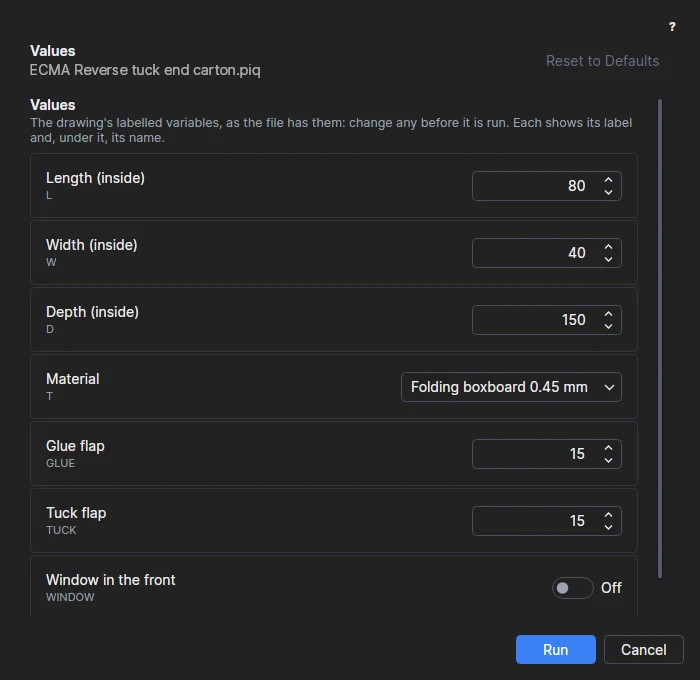
Every variable with a label (given with LABEL, or in its assignment: FLAP=25,"Glue flap"),
in the order the file defines them. That includes L, W and D, the drawing's length, width and depth, which
every drawing starts with, labelled. System variables (those starting with #)
are not asked for. Each is shown with its label and, under it, its name, in a control that suits its value:
| Value in the file | Control | Example |
|---|---|---|
| A number, or an expression that gives one | A number box | FLAP=25,"Glue flap" |
| Text | A text box | CUSTOMER="","Customer" |
TRUE or FALSE |
A switch | LID=FALSE,"With a lid" |
| A list written out, indexed by a fixed number | A choice of its items | GRADE={"Light","Standard","Heavy"}[1],"Board grade" |
| A dictionary written out, indexed by a fixed key | A choice of its keys | TAPER={"None":0,"Small":5,"Large":10}["Small"],"Flap taper" |
A list of numbers written out, not indexed ({}: none) |
A text box: the numbers separated by commas (67, 92) |
WIDTHS={67,92},"Row widths" |
Each starts at the file's own value. A value you don't change stays as the file has it, an expression and all
(CALC=FLAP*2 goes on following FLAP).
How it is run
Each variable you change has its first assignment in the file given your value instead; a choice keeps its list
or dictionary and changes only the index (GRADE={"Light","Standard","Heavy"}[2]), so it is still a choice in the
drawing made. L, W and D, which every drawing starts with, are set before the file starts too, in case it doesn't set
them itself. The file
itself is not changed: the drawing made is new and unsaved, and the values used are listed in the
Interactive window.
Making one
Draw the drawing as usual, on variables: give the ones to ask for a label, write the choices as a list or a dictionary indexed by a fixed key, and use IF for parts that depend on a switch. Start the file with a comment saying what it is: it is shown when the file is chosen. Save it in the Parametric folder of your Extensions folder: File › Save to Library… does that, in the folder you choose (see Parts).
// A tray with glue flaps, and a lid if wanted
L=300
W=200
D=60
T={"E flute":1.5,"B flute":3}["B flute"],"Material"
FLAP=25,"Glue flap width"
GRADE={"Light","Standard","Heavy"}[1],"Board grade"
LID=FALSE,"With a lid"
P10=[L+T+FLAP,0]
LINE P1,P10
IF LID THEN BEGIN
    LINE P3,P2
END
Notes
The text a TEXT element shows is written out in it, so a text variable can't change it; use text variables in expressions (
CONCAT,PRINT, dictionary keys).Templates do the same in JavaScript, with a form of their own.
File › Ask Claude… writes a parametric drawing from a description, in the same form.
Automation scripts run the same designs without the app's window, with values from an order or a CSV file:
runDesign("Packaging › Sleeve", { L: 200 }).
The library is on the website too: the Design Gallery shows every design, opens each in the web viewer to size it, and downloads it as DXF or PDF.