Box Strength
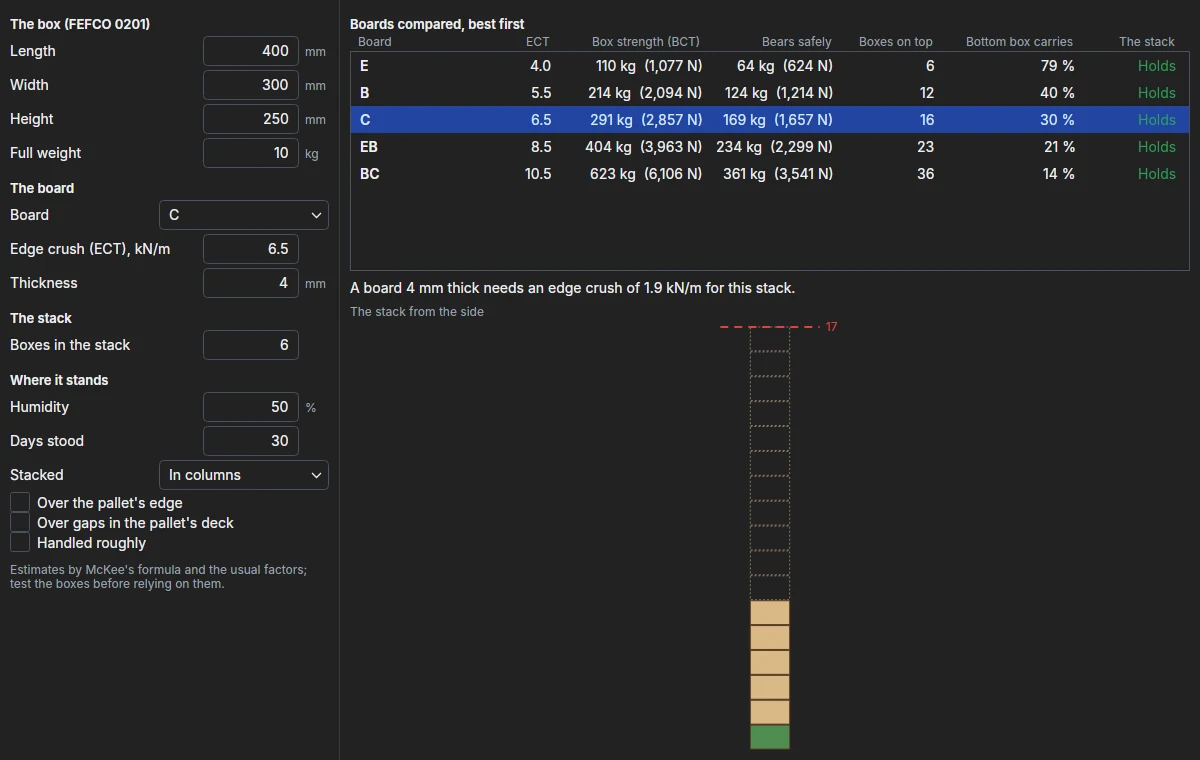
ParametrIQ Box Strength works out how high a corrugated box stacks safely. From the box's size and full weight,
the board's edge crush and thickness, and where the stack stands, it estimates the box's compression strength, what it
bears safely, and how many boxes may go on top, for every common board at once. It is a separate, free program
(PiQ.BoxStrength.App).
Getting Box Strength
Box Strength is free: it needs a ParametrIQ account and its own licence, which costs nothing. Ask for it under ParametrIQ Box Strength on your account's Licenses page, download and install it, and activate it when it first starts, as Free Apps describes.
The box and the board
Type the box's inside Length, Width and Height and its Full weight, the box with what is in it. The box is a regular slotted container (FEFCO 0201).
Choose a Board (E, B, C, EB or BC, which fill in a typical Edge crush (ECT), kN/m and Thickness for that grade), or My own board and type your board's edge crush (kN/m) and thickness from its maker's data sheet. A real board's edge crush varies with its papers, so your maker's figure gives the better answer.
The stack and where it stands
| Setting | What it does |
|---|---|
| Boxes in the stack | How many boxes stand one on another, the bottom one included. |
| Humidity | The air's relative humidity. Above 50 % the board weakens: about a third gone at 80 %, half at 90 %. |
| Days stood | How long the stack stands. Board creeps under load: after 10 days a box bears about 63 % of its strength, after 180 days half. |
| Stacked | In columns (each box squarely on the one below), Columns out of line, or Interlocked (bricked), which loses almost half. |
| Over the pallet's edge | The boxes stand past the pallet's edge. |
| Over gaps in the pallet's deck | The bottom boxes bridge gaps between the pallet's deck boards. |
| Handled roughly | The stack is knocked about in handling. |
Each condition keeps a share of the box's strength, and the shares are multiplied.
The boards compared
Every board is listed for the box, the boards that hold the stack first (the weakest of them first, so the cheapest board that does the job tops the list), then those too weak. Each line gives the board's edge crush, the box's strength (BCT) and what it Bears safely under the conditions, in kilograms and newtons, the Boxes on top it bears, how much of that the Bottom box carries in your stack, and whether The stack holds.
Under the list, a line gives the edge crush the chosen board's thickness needs for your stack. Click a board to see the stack from the side: the bottom box coloured from green (lightly loaded) to red (overloaded), and a dashed line where a safe stack ends.
How it is worked out
The box's strength is McKee's simplified formula: BCT = 5.874 × ECT × √(thickness × perimeter), with the edge crush in kN/m, the thickness and the perimeter (twice the length plus the width) in mm, and BCT in newtons. The conditions' shares are the usual rules of thumb (Kellicut's). These are estimates for choosing a board: test the boxes before you rely on them.
Saving the list
Save list… saves the boards compared as a list (CSV) for a spreadsheet. It needs the licence.