Diameter Dimension Tool
Use the Diameter Dimension Tool to dimension the diameter of a circle or arc: a line across it through its centre, with arrows at both ends and Ø and the diameter above the centre. The dimension follows its points when they move.
Usage
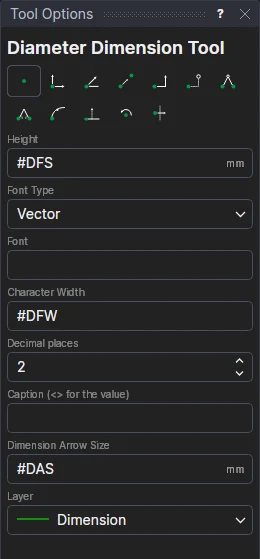
- Set the dimension's options if you need to. Each starts as the drawing's
dimension setting variable: a dimension made with an option left so keeps to the
variable, and changes when it does; change an option here for the dimension to have its own.
- Height: the height of the capital letters, an expression:
#DFS(Dimension Font Size) to begin with. - Dimension Arrow Size: an expression:
#DASto begin with (0 for no arrows). - Font Type and Font: a vector font (an .shx file, or empty for the built-in font) or a TrueType font
(an installed family, or a .ttf or .otf file),
#DFKand#DFNto begin with. TrueType fonts can also be Bold and Italic (#DFB,#DFI). - Character Width: how wide the letters are, an expression:
#DFW(1, normal) to begin with. - Decimal places: the most shown (
#DDP: 2 in millimetres, 3 in inches). Trailing zeros are left off. - Caption (<> for the value): text instead of the measurement, with
<>standing for it (for example<> TYP). Leave it empty to show the measurement. It has no variable.
- Height: the height of the capital letters, an expression:
- Choose the layer to draw the dimension on. It starts as the Dimension layer, if the drawing has one.
- Click* the centre of the circle or arc. The Centre snap finds it parametrically (
CENTEROF(@5)). - Click* a point on the circle or arc. The line across runs from there, through the centre, to the other side.
*Depending on the chosen snap mode, several clicks may be required to define the point parametrically. Read more about Snap Modes